Define the fastener before choosing a production route
A headed wire nail, a small-head brad, a headless pin nail and a two-leg staple are different constructions. Head, shank or wire section, point, crown and presentation must come from the selected product reference or controlled drawing. A machine category does not establish that every construction can be manufactured on one line.
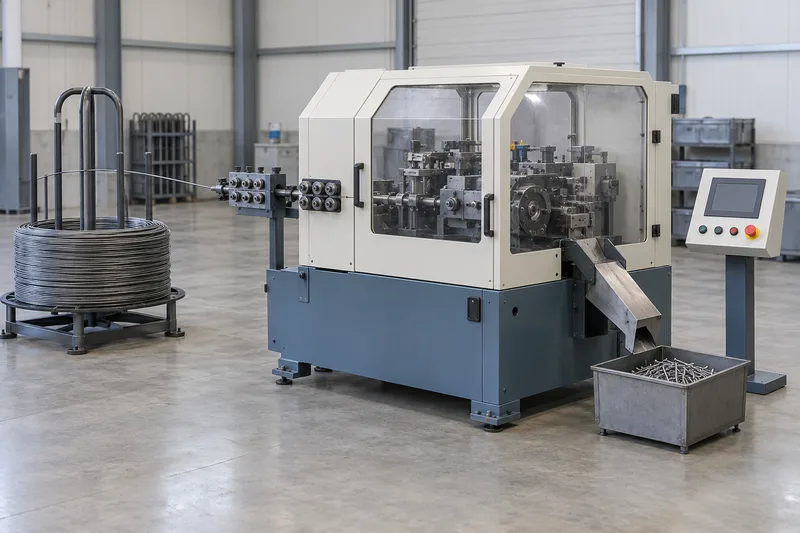
Four operations to keep separate
| Operation | Process distinction | Review input |
|---|---|---|
| Nail-body forming | ENKOTEC describes wire straightening, cutting and head forming in its rotary nail machines. Conventional cut-and-hammer machines use a different forming arrangement. | Head, wire section, length datum, point and specified stock. |
| Nail-shank profiling | ENKOTEC separately identifies rolling equipment for ring- and screw-shank nails. Making the nail body does not by itself specify the shank profile. | Drawing-defined profile and its extent; not a mating screw-thread assumption. |
| Nail collation | ENKOTEC lists wire-coil, plastic-strip and paper-tape collation as distinct configurations, with or without shank profiling. | Exact supplied presentation, spacing, orientation and selected fastener/tool reference. |
| Wire-band staple forming | SSS Hardware describes drawing/flattening wire, combining it into a glued band and dedicated staple forming. This is one supplier configuration, not a universal staple process. | Wire section, crown, leg datum, point and strip requirements. |
Forming, handling and packing are not interchangeable
Separate the incoming stock specification from the finished nail or staple specification. Review preparation, controlled feeding, forming and cutting, any required shank operation, part transfer, finishing, inspection and the selected bulk or collated presentation. Tooling, sequence and handling interfaces must be reviewed for the actual part and equipment.
A collation machine arranges and connects selected fasteners; it is not evidence that a nail-forming machine also makes the complete strip or coil. The manufacturer's configuration examples do not establish universal compatibility between machines, nailers or staple guns. This page supplies no settings or operating instructions; use the actual machine documentation and qualified personnel.
Connect to the existing product construction
- Headed connecting nails: identify the head, point and smooth or profiled shank before reviewing body forming and presentation.
- Finish/brad and headless pin nails: specify the actual head or headless construction and wire section. Neither the word “pin” nor a gauge label selects a machine or installation tool.
- Roofing and duplex nails: keep broad/special head geometry or the two-head arrangement with the drawing; review forming separately for the selected variant.
- Two-leg and fencing staples: crown, wire section, each leg, point and any barb require construction-specific review. A wire-band staple example does not cover every fence-staple form.
- Concrete/steel-base nails or powered pins: forming a part does not qualify the substrate, installation system or holding performance.
Prepare a nail or staple component enquiry
| Requirement | Information to provide |
|---|---|
| Reference and geometry | Exact construction, drawing/revision and units; head or crown, shank/wire section, length datum, legs, points and special features as applicable. |
| Stock and finish | Specified material grade and condition, surface requirements and any required treatment or records. Do not infer these from colour or a machine photograph. |
| Presentation | Loose, strip, coil or other controlled format; collation material, geometry, orientation and packing definition. Provide the exact tool/system reference where relevant for separate review. |
| Acceptance and documents | Controlled dimensions and inspection scope, sample review, lot identification and any separately specified functional or installed-condition verification. |
| Commercial scope | Quantity by variant, packing, destination and requested date. Identify missing information and alternatives; supply and timing require quotation confirmation. |
Finishing and inspection remain separate
The surface-finishing and inspection and sorting guides cover supporting stages. They do not replace dedicated forming or collating equipment. A completed shape or collation does not prove holding load, corrosion life, fire/water performance, tool interchangeability or substrate approval. No universal capacity, tolerance, cycle time, treatment recipe or released installation specification is offered.
Related products and enquiry guidance
Equipment category and order-specific records
This guide explains possible part-specific operations. It is not an installed-machine inventory or proof of factory ownership, capacity, certification, stock or supply availability. Send the finished-fastener requirements for review; the production route and commercial scope must be confirmed for the order.
Technical references
Independent manufacturer resources support these process distinctions, not an installed machine, brand affiliation or commercial relationship. Model specifications and supplier performance claims are not adopted.