Choose the finish around the finished fastener
Surface finishing is a group of operations, not one universal machine. Separate mechanical preparation, cleaning and coating application when reviewing the route for a bolt, nut, washer or formed component. Start with the material, controlled drawing and specified finish rather than equipment appearance.
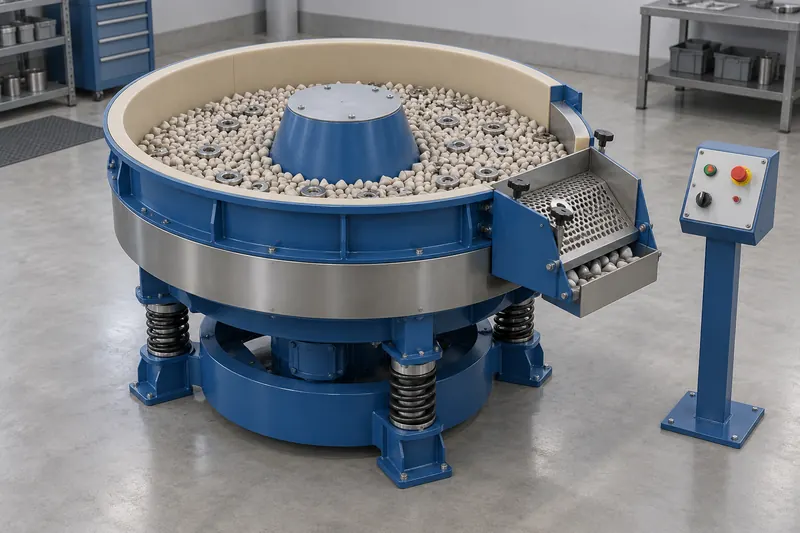
Mechanical finishing and surface preparation
Vibratory finishing brings workpieces and abrasive media into contact in a moving working bowl. Manufacturer examples include an annular channel and a separation screen to recover parts from the media. Deburring, edge rounding and polishing are distinct objectives that require part-specific media and process review.
The pictured equipment represents this mechanical finishing family. It is not a plating tank, dip-spin coater or proof of a particular surface result.
Protect the features that matter
Identify threads, bearing faces, recesses, sharp features and surfaces whose geometry must be retained. Review media access and separation, potential lodging in holes or recesses, part-to-part contact and the required condition after cleaning and drying. A smoother appearance alone does not establish dimensional acceptance.
Coating application is a separate equipment choice
DECC describes dip-spin coating as a basket-based bulk process: parts are immersed in a coating, excess is removed by spinning, and the coating is cured. It identifies small fasteners and some stamping geometries as applications. Suitability still depends on the part and coating; rack-based application is a separate route to evaluate.
Do not equate dip-spin equipment with electroplating equipment or treat every finish as interchangeable. The finish specification must identify the coating system, any supplementary treatment and the acceptance requirements. Mechanical preparation, coating application and curing need their own review.
Plan the route without guessing process settings
- Confirm the part revision, material and exact finish requirement.
- Identify surfaces and threads that require protection or controlled final geometry.
- Review preparation, cleaning, application and any curing stages separately.
- Agree sample review, finished-part checks and lot records.
- Assess the final condition against the agreed requirements.
This is a planning guide, not a chemical recipe or operating procedure. Chemical handling, ventilation, wastewater, guarding and curing safety require qualified personnel and the actual equipment and process instructions.
Prepare a surface-finishing enquiry
| Review point | Information to confirm |
|---|---|
| Part and material | Drawing revision, geometry, material designation and starting surface condition. |
| Finish specification | Exact coating system, supplementary treatment and controlled specification or drawing. |
| Critical features | Threads, bearing surfaces, recesses and areas needing controlled final geometry or protection. |
| Acceptance and records | Agreed sample review, thickness or coverage checks, thread-fit checks, applicable tests and lot records. |
Confirm the result, not just the appearance
Specify the required coating thickness or coverage assessment, final thread-fit checks and any corrosion or friction testing, where applicable. Test methods and acceptance criteria must be agreed for the actual specification. No salt-spray duration, torque coefficient, hydrogen-embrittlement prevention claim or certified finish is promised here.
Review the sequence with heat treatment and finished-part inspection. This guide does not establish an owned coating line or a supplier relationship.
Request finished parts, not finishing machinery
Send the part drawing, finish specification and required records for order-specific review. Equipment appearance does not establish installed inventory, coating capacity, process qualification or supply availability.
Technical references
Independent equipment and technical resources. These references do not establish installed equipment or a commercial relationship.