Start with the specified material and finished properties
Heat treatment changes material condition through a controlled thermal process. The required route depends on the material and the finished-part specification. It should not be added automatically to every fastener, nor selected from the furnace appearance alone.
Different treatments have different purposes
Hardening and tempering
For suitable steels, a hardening route can include heating, quenching and subsequent tempering. Tempering adjusts the hardness and toughness balance after hardening. The approved process is material- and part-specific; no temperature, holding time or quench recipe is prescribed here.
Other material-condition requirements
Annealing, stress relieving and case-hardening treatments serve different objectives. They are not substitutes for one another or for a specified finished grade. Start with the exact material, drawing and applicable specification before considering a treatment route.
Furnace and line arrangement must match the process
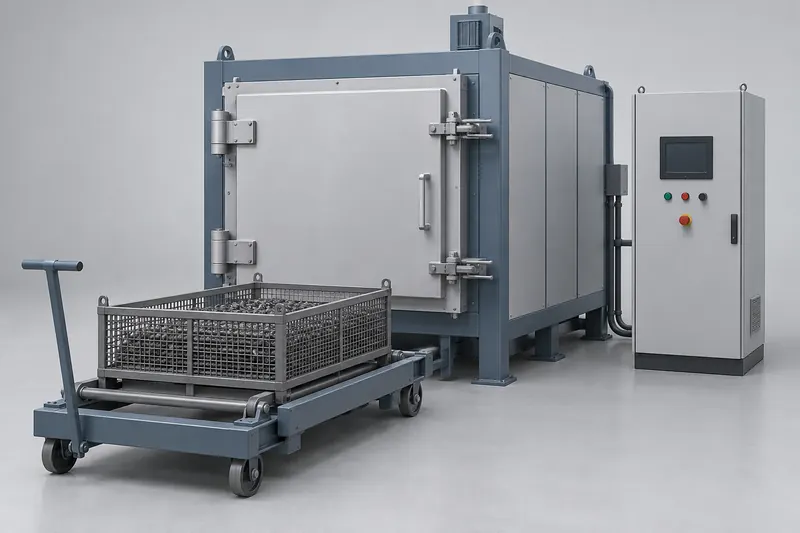
A batch chamber furnace handles a defined load. Continuous lines use a different loading arrangement. Air, protective-gas and vacuum equipment are distinct concepts with configuration-dependent accessories. A closed chamber image does not establish atmosphere control, quenching capability or suitability for a particular alloy.
Nabertherm describes several furnace families and charging accessories; its hardening-system examples also distinguish a hardening furnace, tempering furnace and quenching or cleaning baths. These examples explain equipment selection, not an installed FastenerBridge line or a supplier relationship.
Plan the treatment sequence and records
- Identify the material designation, starting condition and controlled part revision.
- Define finished properties and the applicable specification, including any required treatment restrictions.
- Review loading, process selection and the sequence relative to machining, threading and finish.
- Agree lot identification, process records and the inspection plan.
- Verify the finished requirements before accepting the lot.
This is not an operating procedure. Furnace safety, atmosphere handling, hot-load handling and process control require qualified review and the actual equipment instructions.
What to include in a treatment brief
| Review point | Information to confirm |
|---|---|
| Part and material | Controlled drawing or product specification and edition, material designation and starting condition. |
| Finished requirements | Specified grade or properties, any hardness, case-depth or surface-condition requirements, and their acceptance method. |
| Sequence | Machining and thread-production stages, distortion-sensitive features, treatment and coating order. |
| Evidence | Required lot traceability, process records, agreed hardness or mechanical tests, sample review and report requirements. |
Connect material, grade and finished acceptance
Hardness alone does not establish every mechanical requirement or standard conformity. Define the required tests and records for the actual component. Treatment-related dimensional change, surface condition and finish sequence also require review.
Keep coatings and commercial facts separate
A coating is not evidence of a heat-treatment route. This guide makes no blanket claim of hydrogen-embrittlement prevention, corrosion life, certified grades or furnace capacity. Provide the finished-part specification for order-specific review.
Technical references
Independent equipment and technical resources. These references do not establish installed equipment or a commercial relationship.