Prepare the stock before forming the component
Wire drawing and finished-part forming answer different questions. Drawing equipment prepares or calibrates wire stock; heading, bending, coiling and nail forming create component geometry. Identify the supplied stock condition and the required component before reviewing either stage. A wire-fed part does not automatically require drawing equipment inside the fastener factory.
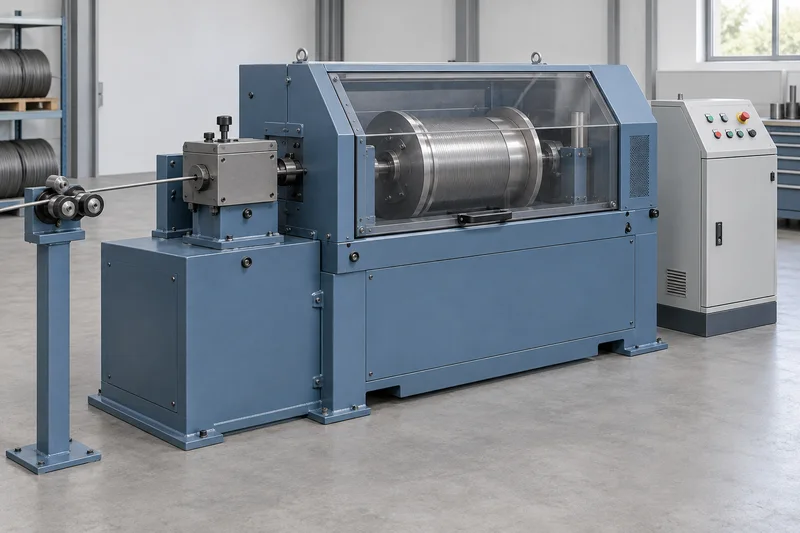
Three stock routes to distinguish
| Route | What to review |
|---|---|
| Supplied prepared wire | Confirm the purchased stock section, material condition, surface and lot records against the component requirement. Tecno Impianti compares in-line drawing with using pre-drawn wire; drawing need not be assigned to the component maker by default. |
| Standalone drawing and recoiling | Drawing and stock take-up can form a separate preparation stage. MFL describes standalone equipment and combined drawing/coiling arrangements. Recoiling stock for handling is not the same operation as forming a finished spring body. |
| In-line drawing | Tecno Impianti places its drawing unit between the payoff and a downstream former, straightener/cutter or bender. Wire calibration and feeding interfaces must be reviewed for that configuration; they are not built-in functions of every forming machine. |
Keep equipment functions separate
A line review should identify how stock enters, which preparation is already complete, what drawing is required, and how stock exits or feeds the next operation. A maker's complete-line example distinguishes the uncoiler, wire-end preparation, drawing unit and feeding unit. It does not establish one mandatory package for every material or part.
- Payoff and handling: identify coil or spool presentation and the required interface with the selected equipment.
- Preparation and drawing: distinguish the incoming material condition from any drawing or surface-preparation scope.
- Straightening, cutting and feeding: review these against the next operation rather than treating them as synonyms for drawing.
- Stock verification: define agreed section, surface, condition and traceability checks separately from finished-part acceptance.
Connect to the downstream component
Continue to cold heading for suitable headed blanks, wire bending and component coiling for selected wire constructions, or nail and staple forming for the chosen fastener. The downstream guide does not determine the incoming stock route. A sheet or strip component, machined bar part or plastic component needs a different review.
Define the stock and finished-part brief
| Review input | Information to confirm |
|---|---|
| Component definition | Drawing, revision, units, construction and specified material. Keep the stock definition distinct from the finished fastener dimensions. |
| Incoming stock | Material grade and delivery condition, section/profile, surface requirements, coil or spool presentation and available lot documentation. |
| Preparation boundary | What the stock supplier has already completed; whether drawing or other preparation is proposed locally or remains outside the order scope. |
| Downstream interface | Required stock section and condition for the selected forming process; any unresolved handling or equipment questions. |
| Acceptance | Agreed stock and finished-part checks, sample scope, traceability, quantity and packing. Identify missing information instead of assuming capability. |
A process category is not a production recipe
Material and equipment limits must be evaluated for the actual route. This page gives no reduction schedule, pass count, speed, tension, die setting, lubricant recipe or chemical-treatment instruction. Setup and operation require the actual machine documentation and qualified personnel. No universal tolerance, throughput, tool life or cost saving is promised.
Stock preparation is also separate from specified finished-part heat treatment, surface finishing and inspection. A drawn wire diameter or equipment image cannot establish a finished fastener grade, conformity or performance.
Equipment category and order-specific records
This guide explains possible stock-preparation routes. It is not an installed-machine inventory or proof of factory ownership, capacity, certification, stock or supply availability. Send the finished-component requirements for review; the production route and commercial scope must be confirmed for the order.
Technical references
Independent maker resources support these distinctions, not an installed machine or commercial relationship. Their model ratings and performance claims are not adopted.