Form the blank before choosing the thread route
Cold heading uses punches and dies to shape wire-derived blanks. A headed fastener can pass through several forming stages before separate threading, finishing and inspection. The heading operation and the finished fastener specification are different decisions.
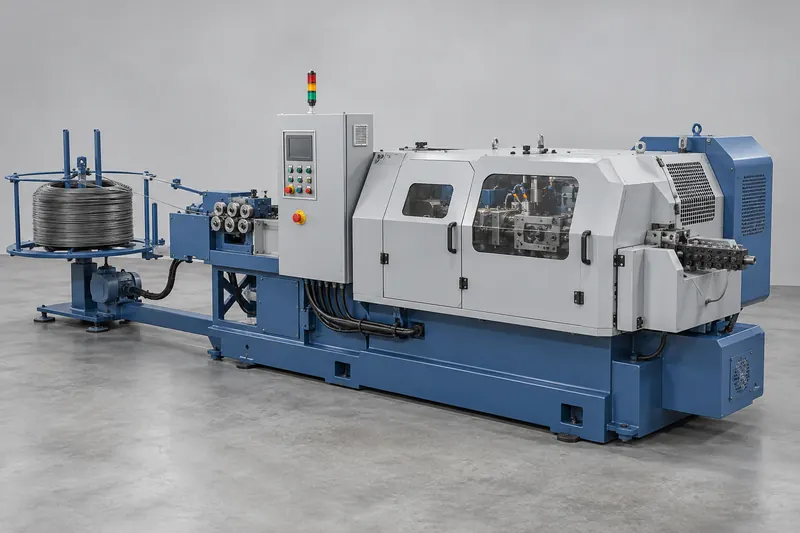
Where it fits in the process
- Wire and tooling preparation: identify the material condition, feed stock and part drawing; plan the forming sequence.
- Feed and cut-off: the feed and cut-off system prepares a blank for forming.
- Heading and transfer: punches work against dies; a multistation machine transfers the part between successive tools.
- Downstream operations: review any required pointing, threading, heat treatment or coating separately.
- Acceptance: check the formed geometry and the agreed final-part requirements, with lot identification.
This is a route overview, not an operating instruction. Set-up, guards, handling and maintenance require the actual machine manufacturer's procedures and qualified personnel.
Single-stage, multistage and combined equipment
Equipment makers distinguish single/double-stroke headers from multistage cold formers. Some combined machines also include pointing and thread rolling; those functions should not be assumed on every cold-heading machine. Start with the part's required geometry rather than a station count alone.
Selected bolt and screw blanks are relevant to this process. Suitability for a particular material, head, shank, hollow feature or order must be evaluated separately. A product-family name is not confirmation that the part can be made on the pictured equipment.
What determines route selection?
| Review point | Information to confirm |
|---|---|
| Controlled geometry | Drawing revision, head and drive form, shank profile, under-head features, dimensions and tolerances. |
| Material and blank | Material designation and condition, feed-stock requirements and any forming restrictions. |
| Tooling and sequence | Forming stages, punch/die design, transfer and ejection requirements; identify any secondary operations. |
| Thread and finishing | Define the separate thread requirement and any heat-treatment or coating requirement. |
| Order acceptance | Quantity, first-sample review, dimensional checks, required mechanical tests and lot records. |
Related fastener enquiries
Compare the finished part first, then agree its production route.
Heading does not establish final performance
A machine appearance or forming route does not prove the finished grade, dimensional acceptance, certification or production capacity. Use the controlled part requirement and agreed inspection plan. If threading is needed, continue to thread-rolling equipment; not every thread is produced by rolling.
Technical references
Independent equipment-maker resources for the process explanations above. References do not establish an installed machine or a commercial relationship.