Shape an external thread with rolling dies
Thread rolling forms an external thread through plastic deformation of a prepared blank. It is distinct from cutting a thread. The thread system, pitch, profile and finished fit must be specified before evaluating a rolling route.
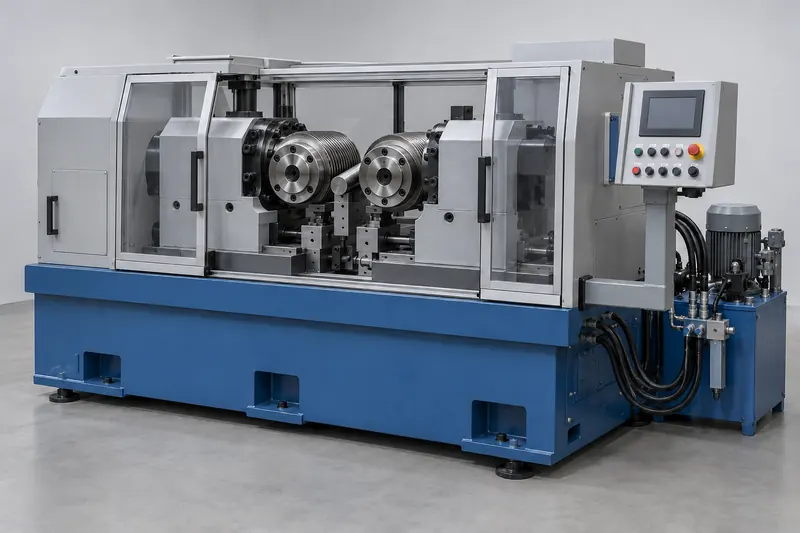
Flat dies and circular dies are different arrangements
Flat-die rolling
One die is fixed while the other moves; die matching and blank entry are important set-up considerations. This is a different arrangement from the two circular dies shown above.
Circular-die rolling
In a two-die arrangement, rotating dies engage a supported workpiece and form its profile. Infeed and throughfeed are separate process options. Infeed works over a selected thread length; throughfeed advances the workpiece axially. Select the actual dies and feed arrangement for the part rather than inferring them from the image.
Blank-to-thread process
- Specify: define thread system, pitch, direction, profile, fit and threaded length.
- Prepare: confirm blank geometry, material condition and the entry/end features needed by the chosen route.
- Set up: select and match dies, support and feed arrangement for the controlled part.
- Roll: the dies engage the blank to form the thread. Material hardness, deformation and contact area influence the required forming force.
- Verify: inspect the finished thread and any required checks after subsequent treatment or coating.
The overview is not a machine operating procedure. Use the actual equipment instructions and qualified process review for safety and set-up.
Information needed for a rolling assessment
| Review point | Information to confirm |
|---|---|
| Thread definition | Exact standard and edition or drawing; nominal size, pitch, direction, thread form, fit and mating component. |
| Blank and length | Controlled blank diameter and tolerances, overall and threaded lengths, shoulder clearance and end geometry; no universal blank-size rule. |
| Material condition | Material designation and condition at rolling; review ductility, hardness and route feasibility for the actual part. |
| Operation sequence | Identify the intended heat-treatment, coating and inspection sequence; do not assume one sequence fits every grade. |
| Acceptance | Thread gauging and dimensional acceptance, surface checks, required part tests, quantity and sample-review scope. |
Related threaded parts
These links identify finished-product families, not a guarantee of a rolled thread on every item. Internal nut threads need a different process assessment.
Keep process selection separate from product approval
Rolling does not by itself establish grade, load rating, fatigue performance or tool compatibility. Specify acceptance for the actual finished fastener. For headed blanks, read cold-heading equipment. Use the thread specification checklist when preparing an enquiry.
Technical references
Independent equipment-maker resources for the process explanations above. References do not establish an installed machine or a commercial relationship.