Buyer cut-list guide · Published 5 November 2026
Order finished threaded pieces by their required length, end condition and piece count. A source-bar length describes material before processing; it does not, by itself, state the dimensions or quantity of the finished goods you want delivered. Put those requirements on separate fields in the enquiry.
This guide turns a mixed length description into a checkable cut list. It complements the fully threaded rod product page, which explains product forms and references.
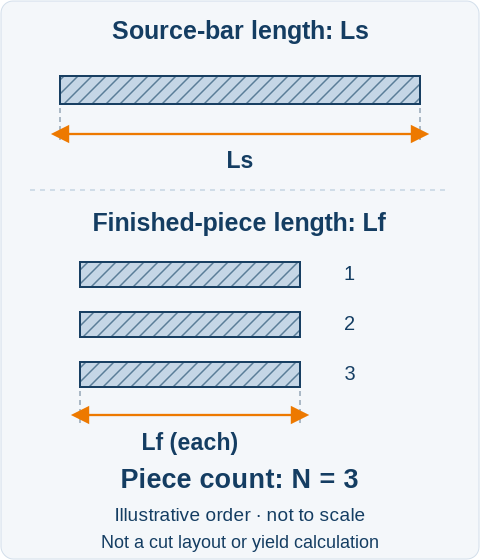
Keep three different questions separate
| Field | What it answers | What still needs confirmation |
|---|---|---|
| Source-bar length, Ls | What length of starting material is being discussed? | Who supplies it, its actual specification and any processing scope. |
| Finished-piece length, Lf | What dimension must each delivered piece meet? | Drawing endpoints, units, tolerance and required finished condition. |
| Finished-piece count, N | How many accepted pieces are required on that line? | Separate counts for different lengths, references or revisions. |
Do not calculate the purchased quantity of source bars merely by dividing total finished length by a catalogue bar length. Cutting losses, end work, material condition and the actual processing plan require separate confirmation. A buyer's finished-parts list is not a guaranteed cutting-yield calculation.
Specify the finished length and its endpoints
Give the drawing number/revision and identify how its length is measured. The illustration uses finished end-to-end length for clarity. If the selected product specifies another reference, preserve it instead of replacing it with that illustration.
For example, Portland Bolt's all-thread explanation distinguishes end-to-end rod measurement from a first-complete-thread reference used for fully threaded studs in its discussion. That is a reason to read the governing requirement, not a universal rule that every product called a stud uses one convention.
Record the required length tolerance from the controlled specification; write “to be confirmed” when it is missing. Tie acceptance to the required delivered condition, including any specified end work or surface treatment. Do not insert a generic allowance or convert an approximate sample reading into an approved production dimension.
Build a cut list by finished part
Use one line per distinct requirement. The blank rows below are enquiry fields, not available sizes or completed orders.
| Cut-list field | What to enter |
|---|---|
| Line and part identity | [line]; [part/reference]; [drawing/revision]. |
| Thread and material | [system, diameter, pitch, hand and fit]; [material/property requirement]. |
| Finished length | [value/unit]; [endpoints]; [specified tolerance/reference]. |
| Ends and finish | [end detail on each end]; [required finished surface condition]. |
| Quantity and identification | [number of finished pieces]; [line/lot/marking requirements]. |
| Open items | [unresolved input]; [responsible reviewer]. |
As a first-party example of the information a processor needs, HBS requests a cutting list that identifies quantity, length, end treatment and marking for each item. Its process and service promises belong to that supplier. Use the example to make your own requested scope explicit; cutting, end finishing and marking are not automatically included in a FastenerBridge quotation.
If a metric stud-bolt reference is requested, DIN 976-1:2016-09 is identified by DIN Media as the metric-thread stud-bolt standard. Retain the selected edition and end form. The reference alone does not supply a missing cut list, establish a tolerance here or certify the quoted goods.
Compare source material with finished goods correctly
Suppose the enquiry requests three pieces at the drawing-defined finished length. One offer covers finished pieces with the requested end condition; another covers long rods for later processing. Those offers describe different supply scopes, even if their thread designation and total quoted material length look similar.
- Confirm the delivered item. Is the quoted unit a source rod or a finished cut piece?
- Match each cut-list line. Check finished length, endpoints, specified tolerance, thread and material.
- Resolve the end condition. Identify required cut-face, chamfer or other drawing-defined details, plus any specified coating condition at the ends. Request confirmation of the applicable inspection; do not prescribe an unverified reworking method.
- Confirm count and records. Keep finished-piece quantities and required line/lot identification separate from any source-material quantities.
- Record exclusions. Resolve processing, finishing, marking, packing and other differences before comparing the accepted quotation scope.
Send a concise clarification note
Blank note: Please quote finished fully threaded pieces to [drawing/revision]. Each cut-list line states [finished length, units, endpoints and tolerance], [thread/material], [ends and delivered finish] and [piece count]. Any source-bar supply is [separate scope / to be confirmed]. Please list proposed deviations and excluded operations separately.
Complete the thread checklist and use the counting-unit guide if pieces and packs are mixed. Send multiple lines through the bulk enquiry route, or use drawing-based requirements for unresolved custom geometry. Supply feasibility, final dimensions, inspection, charges and timing are confirmed for the actual order.