When comparing prevailing-torque lock nut offers, identify the locking construction and the required service environment separately. A nut with a non-metallic insert and an all-metal nut are different constructions. Neither name alone establishes suitability for a particular temperature, chemical exposure or assembly.
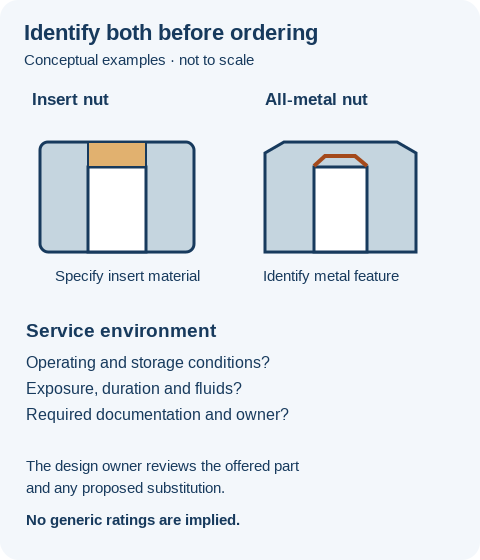
Identify the offered construction
Insert nut: identify the exact part reference and insert material. The phrase “non-metallic insert” alone does not specify a particular polymer. Request the drawing and documentation for the offered nut.
All-metal nut: identify the actual locking feature and its drawing. Metal-only designs can differ; a generic appearance is not sufficient to establish functional or dimensional equivalence.
Separate the environment from the part name
Provide the design-defined operating and storage conditions, exposure duration and any relevant fluids, cleaning agents or other surroundings. State the applicable drawing, standard or project requirements and ask the supplier for documentation covering the exact offered part. The responsible designer determines whether that evidence addresses the assembly requirement.
Example: an offer leaves the exposure question open
A buyer requests a lock nut for an assembly whose drawing specifies environmental exposure. The offer says “locking nut” and matches the thread, but does not identify the locking construction or provide the evidence requested for that exposure. The buyer cannot close the review on thread size alone.
- Ask for the precise part reference, locking construction and applicable drawing or data sheet.
- Provide the documented service and storage exposure requirements, without assuming an acceptable limit.
- Send the offer and evidence to the design owner. If an alternative construction is proposed, request explicit approval before treating it as a substitute.
Include in the enquiry
- Nut drawing, revision, required construction, material and finish; insert material where applicable.
- Thread designation, mating fastener, geometry and quantities.
- Operating and storage conditions, exposure and duration as defined by the project.
- Specified functional checks, documents and acceptance owner; mark missing conditions for review.
Use standards as identities, not automatic approvals
ISO 7040:2025 identifies regular prevailing-torque hex nuts with a non-metallic insert; ISO 7719:2025 identifies all-metal regular prevailing-torque hex nuts. These references describe specific families, not proof that a proposed part meets a particular service requirement. Earnest Machine’s lock-nut overview illustrates construction differences. Do not infer a temperature range, chemical resistance, reuse limit or tightening instruction from the comparison.
See nylon-insert lock nuts, all-metal lock nuts and the thread specification checklist. Request a quotation with the drawing and service requirements.