Produce the internal thread after preparing the blank
Nut tapping concerns the thread inside a prepared hole. It is different from external thread rolling on a bolt or stud. Start with the finished nut drawing, thread requirement and hole condition rather than assuming a production route from the nut name.
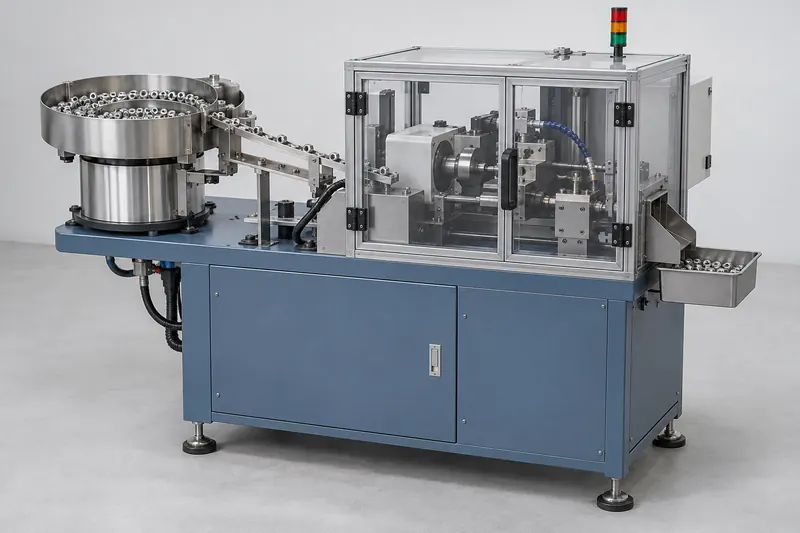
Machine arrangement depends on the part
Nut tappers can use different feed and spindle arrangements. WAFIOS describes a single-spindle reversing machine for blind holes and long parts, with oriented feeding. That arrangement is a manufacturer example, not a specification of the pictured machine. Through-hole, blind-hole and long coupling-nut work require separate assessment.
Cutting taps and forming taps
A cutting tap removes material and produces chips. A forming tap displaces suitable workpiece material to create an internal thread. The hole preparation and tool selection must match the chosen process; the two tap families are not interchangeable. Forming suitability depends on the actual material and application.
From blank to accepted nut
- Identify the controlled nut geometry, thread system, pitch, direction and fit.
- Confirm the prepared hole, entry chamfer, material condition and workholding surfaces.
- Select the tapping method, tool, feeding and chip-handling or forming requirements for the part.
- Plan any subsequent treatment or finish, and define when the thread is inspected.
- Verify the agreed finished dimensions and thread acceptance, with lot identification.
This is a process overview, not an operating instruction. Guarding, set-up, lubrication and maintenance require the actual machine and tool instructions and qualified personnel.
Prepare a nut-tapping brief
| Review point | Information to confirm |
|---|---|
| Thread | Exact standard and edition or drawing; size, pitch, direction, fit, threaded length and mating part. |
| Hole and body | Through or blind hole, prepared-hole condition, chamfer, nut body dimensions and clamping access. No universal pre-drill size is specified here. |
| Material and sequence | Material designation and condition at tapping, heat treatment and coating sequence for the finished nut. |
| Acceptance | Agreed gauging and dimensional requirements, finish checks, quantity, sample review and lot records. |
Related nut families
The actual thread route must be reviewed for each nut construction. Sheet-metal clip nuts and other formed thread features should not automatically be treated as tapped solid nuts.
Keep equipment selection separate from product approval
Machine appearance does not establish thread conformity, grade, capacity or supply availability. Submit the finished nut requirement for part-specific review. For an external thread, use the thread-rolling guide.
Technical references
Independent equipment and tool-maker resources. These references do not establish an installed machine or commercial relationship.