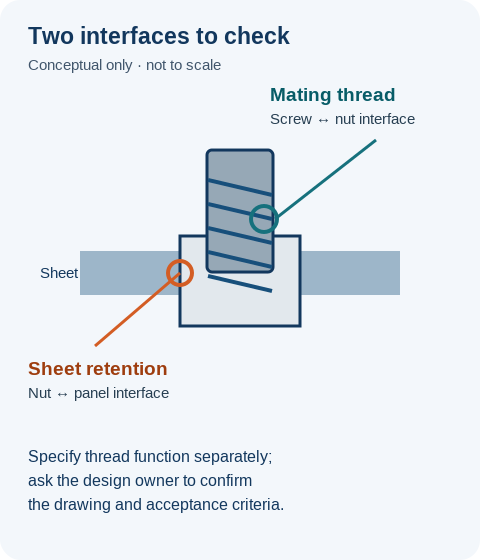
A self-clinching nut has two different interfaces to check: how the nut is retained in the sheet, and how the mating screw engages its thread. Confirm each separately. A description of the sheet attachment alone does not establish that the thread has the locking function requested by the buyer.
Identify the two requirements
Sheet retention: identify the sheet material and thickness, mounting hole and the nut construction on the controlled drawing. Ask which manufacturer drawing and installation information apply to the offered part.
Mating thread: specify thread designation and the required thread function, such as free-running or a separately specified locking construction. Refer the locking requirement and its acceptance method to the responsible designer. Do not assume the word “clinching” describes that function.
Example: a quotation with a missing answer
A buyer asks for a self-clinching nut with a locking thread for a defined panel assembly. The quotation identifies a self-clinching nut and sheet retention, but does not confirm the thread-locking construction. The offer cannot yet be treated as satisfying that requirement.
- Ask the supplier for the exact offered part drawing and identify any thread-locking feature.
- Send the drawing, panel details and intended mating screw information to the design owner.
- Ask the design owner to confirm the required acceptance documents and criteria; request a revised quotation if the offered construction is different.
This is an enquiry example, not an installation or performance specification. The exact drawing and agreed acceptance requirements govern the order.
What to send with an enquiry
- Drawing and revision, part identification and quantity.
- Panel material, thickness, hole and any relevant assembly constraints.
- Thread designation, mating screw details and the required free-running or locking function.
- Finish and other requirements on the controlled drawing, plus the documents needed for acceptance.
Avoid a common mix-up
Do not use sheet retention as a substitute for specifying thread function, or use a general locking label as proof of the assembly’s suitability. Different designs and acceptance methods need separate confirmation.
Sources and further reading
For background on the panel interface, see PennEngineering self-clinching technology. Its PEM RT locking technology describes a particular locking construction; it is an example, not a claim about other products.
See our self-clinching nut selection page, thread specification checklist and screw specification checklist. Request a quotation with the drawing and requirements.