A closed-end blind rivet identifies a body construction; a sealing requirement belongs to the defined assembly and its specified conditions. Ask what must be sealed, under which conditions and how the finished joint will be accepted. A product name alone does not establish the result for an unidentified joint.
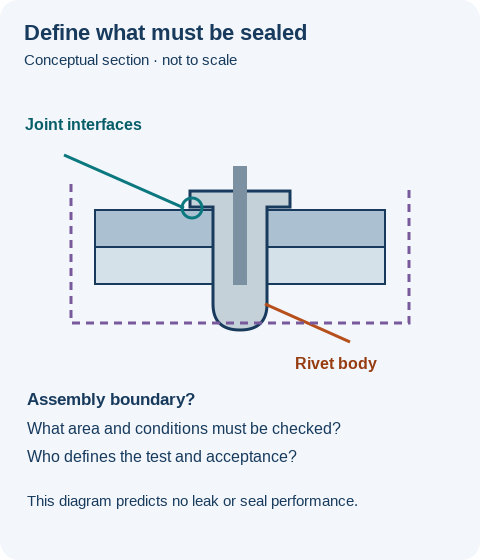
Define the boundary before asking for a result
Rivet body: identify the offered part, its drawing and revision, body and mandrel materials, head and closed-end construction. Request the exact product documentation for any sealing claim.
Joint interfaces: identify the hole, panel stack and the surfaces around the head and between parts on the controlled assembly drawing. These are assembly details to review; the diagram does not predict a leak path.
Acceptance boundary: ask the design owner to specify what area or assembly must be assessed, its environment and the required test or other evidence. Include the actual media, exposure conditions and any applicable project procedure if specified; do not invent a pressure or rating.
Example: a closed-end offer with an open question
A buyer’s enclosure drawing requires a sealing assessment. A quotation names a closed-end blind rivet but gives no test boundary, assembly conditions or acceptance documents. The quoted construction alone does not answer whether the project requirement is met.
- Request the exact offered product reference and its technical documentation.
- Provide the joint drawing and revision, stack and hole details, assembly environment and the project’s sealing requirement.
- Ask the design owner to define the applicable verification and accept the evidence for the actual joint; resolve missing inputs before approving the offer.
Include in the enquiry
- Rivet reference and drawing, quantity, body and mandrel materials, head and finish.
- Joint drawing and revision, stack limits, hole and access information.
- Assembly boundary, specified medium and environmental conditions.
- Project-defined verification, acceptance documents and owner of any unresolved requirement.
Use manufacturer information in context
GESIPA describes its CAP blind rivet as a cup-shaped product intended for sealed connections. The POP Avdel catalogue also describes closed-end construction for its own products. Those statements concern identified manufacturer products; they do not establish a rating for another rivet or an unverified assembly.
Continue to blind rivets, the rivet specification checklist and the grip-range guide. Request a quotation with the drawings and acceptance requirements.