Buyer drawing guide · Published 8 November 2026
Compare the washer, fastener and seat drawings before closing the quotation. A nominal fastener size does not by itself establish the washer bore, its outside diameter or the space available in a recessed seat. Record each controlled dimension separately and send missing interface information to the drawing owner.
Three drawings, three questions
The washer drawing identifies its bore, outside profile and thickness. The fastener drawing identifies the relevant shank and head geometry. The assembly drawing identifies the seat envelope, depth, bearing surfaces, reference faces and any stated clearances. Compare the selected revisions in their specified delivered condition.
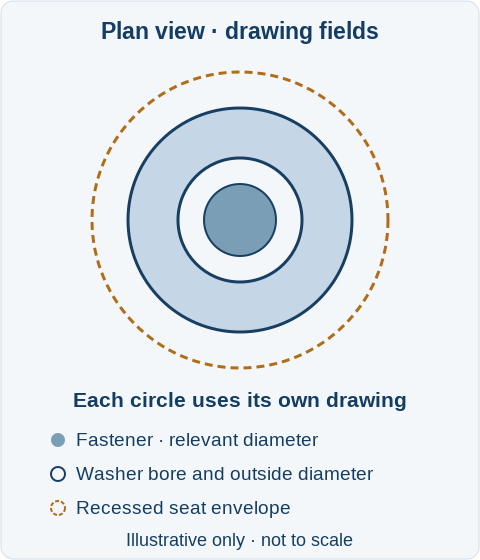
The flat-washer detail introduces the separate bore, outside diameter and thickness fields. ISO identifies ISO 7089:2000 as a normal-series plain-washer standard. Record the specified edition or drawing rather than assuming a nominal size supplies every interface dimension.
Build a drawing handoff
| Document | What to record | Who resolves gaps |
|---|---|---|
| Washer | [Reference/revision] [bore] [outside diameter] [thickness] [units and tolerances] | Washer drawing owner or quoting supplier |
| Fastener | [Reference/revision] [relevant diameter and head profile] [finish condition] | Fastener drawing owner |
| Assembly seat | [Reference/revision] [seat envelope and depth] [datum] [specified condition] | Assembly drawing owner |
Maintain the original units and tolerances, note which faces define each measurement, and flag any coatings or edge details that the controlled requirements make relevant. Do not convert a catalogue label into an unverified mating dimension.
Example of an incomplete offer
An enquiry asks for a washer to a drawing, used in a recessed seat. A supplier offers a normal-series washer and lists its nominal fastener size, but the offer includes no washer drawing and the buyer has not supplied the seat envelope. The seat information belongs to the assembly drawing. The offered washer dimensions belong to the supplier’s identified product document.
- Request the offered washer reference, drawing revision, bore, outside diameter, thickness and applicable tolerances.
- Ask the assembly owner for the controlled seat envelope, depth and reference faces. Keep the field open if the information is unavailable.
- Give both documents to the responsible reviewer and record any unresolved dimensional or finish exceptions before comparing the quotation.
A wider washer, a thicker washer and a different material are separate changes. Ask for approval of any proposed alternative against the assembly requirements.
Clarification to send with the enquiry
“Please quote [washer drawing/reference and revision], quantity [pieces]. Please identify the offered bore, outside diameter, thickness, material and finish on your controlled document. The recessed-seat envelope is [attached / pending]. Please list any drawing deviations and the documents required to review the interface.”
Use the quotation quantities guide for order units and the drawing-based enquiry for special profiles. The responsible assembly review determines fit and acceptance.