Build the route around sheet or strip geometry
Stamping equipment uses tooling to cut or shape sheet and strip. A flat washer may require piercing and blanking; a spring clip may require additional bending and forming. These are different part constructions, and not every washer or retaining component follows the same route.
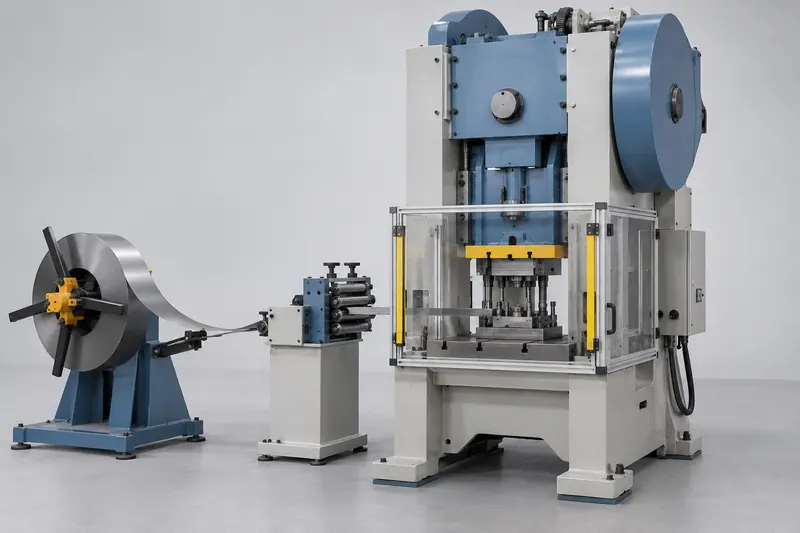
Press tooling and multislide forming
A strip-fed press advances material through tooling. A progressive tool can combine selected operations across stations. Multislide forming uses a different tooling arrangement for stamped and bent parts. Bihler offers several stamping/forming system architectures; additional assembly or thread-related modules are configuration-dependent, not universal features of a press.
Flat washers and formed clips need different reviews
Piercing and blanking
For a flat washer, control the hole, outside profile, thickness, flatness and edge condition. Tool clearance, stock condition and the defined burr direction are process-review questions, not values to infer from a photograph.
Bending and forming
For a formed clip, also define bend geometry, functional gap, spring-material condition and the mating sheet or assembly. Required treatment and finished function belong in the controlled drawing and acceptance plan.
Typical planning sequence
- Specify the drawing revision and sheet or strip material condition.
- Plan coil handling, straightening where required, and the selected feeder.
- Define piercing, blanking and any forming operations in the tool sequence.
- Review edge finishing, treatment and coating as separate requirements.
- Inspect the agreed finished geometry and any specified functional checks.
The sequence varies with tooling and part construction. It is not a press set-up or operating procedure. Use the actual machine instructions and qualified tooling and safety review.
Information for a stamping assessment
| Review point | Information to confirm |
|---|---|
| Drawing | Profile, holes, thickness, tolerances, flatness, bend features, burr direction and critical mating dimensions. |
| Stock | Material designation, temper or condition, strip requirements and any direction-sensitive forming constraints. |
| Tool and machine | Tool layout, feed pitch, die height, force and stroke requirements must be evaluated for the actual part and machine; no generic rating is promised. |
| Finished acceptance | Edge condition, heat treatment or finish where specified, sample review, dimensional and functional checks, quantity and lot records. |
Related product enquiries
These links identify products to discuss, not a claim that every item is made on the pictured equipment. Machined, wire-formed and other constructions need their own route assessment.
Discuss the finished component
Equipment appearance does not establish installed inventory, output, certification or load performance. Provide the part drawing and acceptance requirements for review. Return to the equipment guide to compare routes.
Technical references
Independent equipment and tool-maker resources. These references do not establish an installed machine or commercial relationship.